




- Lead News
- Education
Salaries of Primary School Teachers to Be Suspended If Students Fail to Read Bangla and English
- লিড নিউজ
- Education
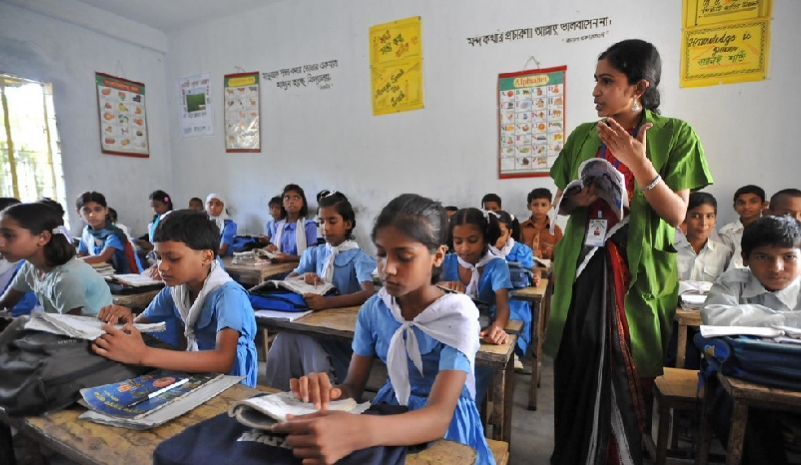
Photo: Collected
News Desk: By July of this year, students in all government primary schools across the country must be able to read Bangla and English fluently. Within the same period, they must also achieve strong proficiency in basic mathematics, including addition, subtraction, multiplication, and division. It has been stated that if schools fail to ensure 100 percent accuracy in reading and mathematical skills among students within the stipulated time, the salaries of the teachers of those schools will be suspended.
Recently, in a virtual meeting with primary education officers from all districts of the country, targets were set by Secretary of the Ministry of Primary and Mass Education Mohammad Sakhawat Hossain. Following the secretary’s instructions, district primary education officers have already sent letters to head teachers and assistant teachers of schools.
The instructions call for students to be made to read aloud five pages daily from Bangla and English textbooks. At the same time, emphasis has been placed on teaching addition, subtraction, multiplication, and division in mathematics.
According to sources from the Directorate of Primary Education, Secretary Mohammad Sakhawat Hossain held virtual meetings with all district primary education officers on 27 April and 5 May. He emphasized strengthening Bangla, English, and mathematics learning for students of classes three, four, and five.
He instructed that by June, 90 percent of students in classes three, four, and five should be able to read Bangla and English fluently, and by July, this should reach 100 percent proficiency.
Meanwhile, following the secretary’s instructions, several district primary education offices have already issued letters to head teachers and assistant teachers to achieve these targets. A letter from the Thakurgaon District Primary Education Office shows that specific targets have been set to implement the secretary’s directives.
The letter states that, according to instructions from the Ministry of Primary and Mass Education, by June, 90 percent of students in class three should be able to read Bangla fluently, class four students should master the four basic operations of mathematics (addition, subtraction, multiplication, and division), and class five students should be able to read English fluently. By July, this target must be raised to 100 percent.
According to district office instructions, students in class three must read five pages daily aloud from Bangla textbooks, and class five students must do the same with English textbooks. In addition, special emphasis has been placed on teaching addition, subtraction, multiplication, and division to class four students alongside their regular lessons.
Teachers have been warned in the letter that if they fail to achieve the required skills within the stipulated time (June–July), their salaries and allowances will be suspended. In this situation, head teachers and assistant teachers of each school have been instructed to prepare plans to ensure students achieve the expected competencies and submit them to the district education office by 10 May.
When contacted, Thakurgaon District Primary Education Officer Md. Mofazzal Hossain said, “We issued the letter today; it is correct. Similar instructions will be issued by other district primary education officers as well, and some have already done so. This is the secretary’s directive. He set these targets in two virtual meetings with us.”
Regarding the instruction to suspend salaries if targets are not met, he said, “This has also been communicated to us by the ministry and the directorate. We have warned the teachers. If students cannot read, the teachers will not receive salaries and allowances — this has been informed by higher authorities.”
Concerns over exams and tight schedule
The Ministry of Primary and Mass Education has set a three-month timeline covering May, June, and July. However, during this period, schools also have examinations and other activities, making it difficult for teachers to meet the targets, according to teacher leaders.
Chairman of the Primary Teachers’ Demand Implementation Council and President of the Bangladesh Primary School Assistant Teachers Association Mohammad Shamsuddin Masud said, “The first-term assessment is currently ongoing in schools. This exam will continue for several days. After that, there is the National Primary Education Award competition. So there is no scope to follow the ministry’s instructions this month. Then there will be Eid-ul-Adha holidays. Overall, May and June will be spent on exams, competitions, and holidays. Yet a target of 90 percent achievement has been set for June. I believe the time frame is not realistic.”
Rasheda K. Choudhury, Executive Director of Campaign for Popular Education, who has long been involved in research and surveys on primary education, said, “Work cannot be achieved through ultimatums. However, giving instructions is positive. Some level of pressure should exist. Teachers must be monitored to ensure they teach properly. At the same time, teachers need proper training. With training, teachers can make learning enjoyable for students. The curriculum must also be updated. Exam pressure should be reduced, and more focus should be given to learning. Only then can the situation improve in the long term.”
Disagreement over wording of instructions
Students are not able to read Bangla and English textbooks fluently and accurately, and many cannot perform basic arithmetic. They are required to read five pages aloud daily. Teachers have expressed disagreement with the way these instructions generalize students’ abilities.
An assistant teacher of a government primary school in Rajbari, speaking on condition of anonymity, said, “It is not true that students in classes three, four, and five cannot read Bangla. Perhaps one or two very weak or irregular students may struggle. But it is not correct to say they cannot read at all. Most students can perform basic arithmetic operations, and teachers assist where they face difficulties.”
Teacher leader Mohammad Shamsuddin Masud made a similar claim, saying, “There is not much problem in Bangla reading. In very remote schools where students do not attend regularly, there may be some gaps. Otherwise, there is no major issue. However, there are some problems in English, which also exist at the secondary level and in madrasas, because English is a foreign language. There are gaps in teaching and learning it. But describing the situation in this way is not appropriate. Still, since it is a government directive, we must follow it and try to improve teaching.”
Secretary of the Ministry of Primary and Mass Education Mohammad Sakhawat Hossain said, “Several instructions have been given to district primary education officers, including ensuring that students can read Bangla and English properly. This must be done; otherwise, the current government’s goals cannot be achieved.”

Farid Ahammad Rony presents his photography book to Franç...
1
Staff Correspondent: Bangladeshi photographer Farid Aha...

Admission to Class XI Without Entrance Exams, Application...
2
News Desk: There will be no admission test for Cla...
How SSC and HSC Examination Question Papers Are Prepared
3
News Desk: Errors found in a Higher Secondary Certificate (HSC) Physics First...

Students Announce Long March Programme for Wednesday
4
News Desk: HSC examinees have announced the suspen...
Education Minister Expresses Deep Regret
5
News Desk: Education and Primary & Mass Educat...



মন্তব্য (0)