- Lead News
- Health
The government has distributed 2.5 million E-Health Cards at a cost of 1.62 billion: Health Minister.
- লিড নিউজ
- Health
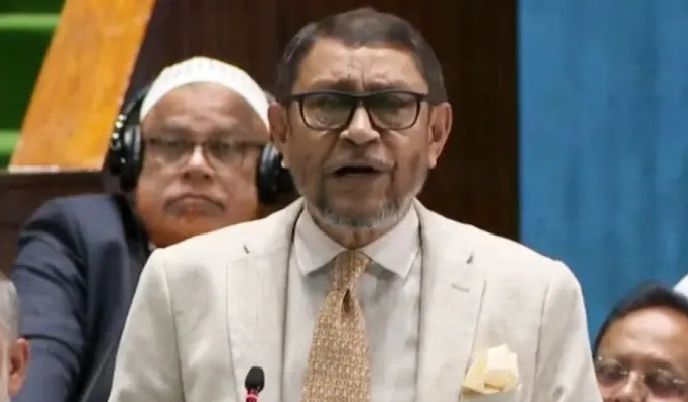
Photo: Collected
News Desk: Minister for Health and Family Welfare Sardar Md. Sakhawat Hossain informed the National Parliament (Jatiya Sangsad) that the government has undertaken a series of mega projects and reform initiatives. These include modernizing the grassroots healthcare system to expand services for ordinary and marginalized people, establishing five specialized children's hospitals, introducing E-Health cards, and rapidly recruiting 5,000 physicians and 100,000 healthcare workers. For this reason, a record budget allocation of 69,409 crore taka has been kept for the health sector in the current fiscal year. The government plans to raise the budget allocation for this sector to 5% of the GDP in the future. During this time, he further added, "Under a pilot project worth 162 crore taka, 2.5 million (25 lakh) E-Health Cards have been distributed in Khulna, Noakhali, Bogura, Sirajganj, and Narsingdi districts."
Health and Family Welfare Minister Sardar Md. Sakhawat Hossain shared this information today, Monday (July 13), during the question-and-answer session on the 23rd day of the second and first budget sessions of the 13th National Parliament, in response to a query from Sultana Ahmed, a member from the reserved women's seat.
The Minister said, "The highest priority has been given to the health sector in the budget and policies of the 2026-27 fiscal year. The government has announced a transformation of the medical system from a 'treatment-centric' to a 'preventive-centric' model. In line with the electoral promises, a target has been set to gradually elevate the health sector allocation to 5% of the GDP within the next five years. As the first step of this plan, an allocation of 69,409 crore taka has been proposed for the health sector in the proposed budget for the 2026-27 fiscal year, which is nearly double the previous fiscal year's allocation of 35,477 crore taka and represents 1.02% of the GDP."
He informed that a 'Primary Healthcare Unit' will be formed in every union and every urban ward, modeled after the General Practitioner (GP) system in the United Kingdom. Three community clinics will be operated under each unit. Furthermore, initiatives have been taken to upgrade upazila hospitals to 101 beds and introduce 24-hour emergency, indoor-outdoor treatment, and modern pathology services. For the first time, positions for both male and female physiotherapists have been created in every upazila hospital.
He also stated that to reduce the pressure on Dhaka, district hospitals will be modernized to introduce treatment for cancer and kidney diseases. Additionally, upazila health complexes will be linked with district hospitals to build an integrated 'Secondary Healthcare Unit'.
The Minister said, "As part of universal health coverage, E-Health Cards are being introduced, which will be linked to an integrated patient management and referral system. Under a pilot project worth 162 crore taka, 2.5 million (25 lakh) E-Health Cards have been distributed in Khulna, Noakhali, Bogura, Sirajganj, and Narsingdi districts. Through this, doctors will be able to view a patient's previous prescriptions and medical history."
He further announced that five specialized children's hospitals with a capacity of 200 beds each will be launched within the next six months in the Khulna, Barishal, Rangpur, Rajshahi, and Cumilla divisions. These hospitals will feature ICUs and central air conditioning systems. Alongside this, a national ambulance pool and an emergency service network will be developed.
To address the shortage of manpower, the process of rapidly recruiting 5,000 MBBS doctors is currently underway. In addition, 100,000 new healthcare workers will be recruited, approximately 80% of whom will be women. There is also a plan to recruit two midwives per union, totaling 25,000 midwives over the next three to four years.
The Minister stated that a competency-based MBBS curriculum will be introduced by 2030, and the use of Artificial Intelligence (AI) in medical training will be ensured.
He also informed that the national list of essential medicines is being updated and a new drug policy is being formulated to reduce medical expenses. At the same time, a policy decision has been made to set up a specialized Medical Technology Park and provide low-interest financing to encourage the domestic production of medical equipment, including syringes, ventilators, X-ray, and ECG machines.
Eight More Children Die with Measles Symptoms
1
Eight children died with measles symptoms across the country in the past 24 hours. During the ...
Views-exchange meeting held between rural physicians and ...
2
Satkania (Chattogram) Correspondent: A view-exchange meeting was held in Satk...
2 more children die from measles symptoms
3
News Desk: Two more children have died with measles symptoms across the count...
Three More Die of Dengue, Another 458 Hospitalized
4
News Desk: Three people, including two women and o...
6 more children have died with measles symptoms in the la...
5
News Desk: In the last 24 hours, six more children have died with measles sym...



মন্তব্য (0)