
- Lead News
- Financial
Government Targets Over US$10 Billion in Earnings from the Leather Sector: Industries Minister
- লিড নিউজ
- Financial
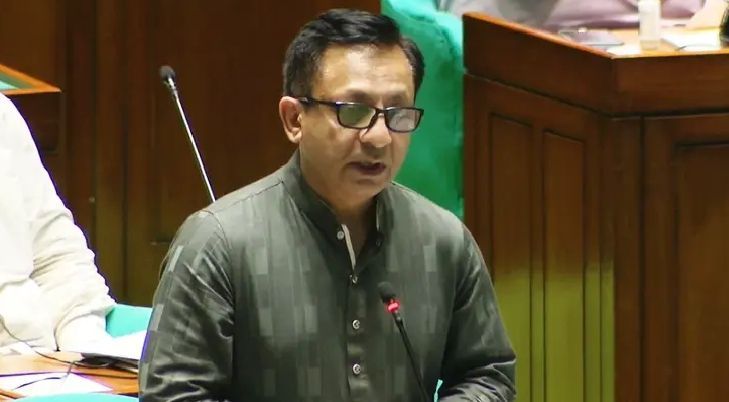
Photo: Collected
News Desk: Commerce and Industries Minister Khandaker Abdul Muqtadir has said that Bangladesh has the potential to earn more than US$10 billion annually in foreign exchange by exporting leather and leather goods produced from domestically sourced raw hides. He stated, “Bangladesh can generate up to US$10 billion each year through the export of leather and leather products manufactured from locally produced raw hides.”
The minister made these remarks on Tuesday (7 July) while responding to an urgent public importance notice raised by opposition lawmaker Shahjahan Chowdhury (Chattogram-15) under Rule 71 of the Rules of Procedure during a parliamentary session chaired by Speaker Hafiz Uddin Ahmed Bir Bikram.
He noted that Bangladesh is currently utilizing only 0.26 percent of the potential of its leather industry. According to the minister, if long-standing structural problems are addressed, leather production and exports could increase by 12 to 14 times.
The minister explained that about two decades ago, foreign buyers imposed fewer compliance and environmental requirements, allowing even non-compliant tanneries in Bangladesh to export raw hides. However, compliance has now become a fundamental requirement, placing the country's leather exports under severe pressure.
He emphasized that unless the Central Effluent Treatment Plant (CETP) at the Savar Leather Industrial Estate is operated by a professionally competent organization, it will be difficult for Bangladesh's leather industry to meet increasingly stringent international compliance standards.
The minister further stated that the relocation of tanneries from Hazaribagh to Savar remains incomplete because essential environmental infrastructure is still not being operated effectively.
To address these challenges, the government has undertaken initiatives to make the CETP fully operational. Although the facility was originally designed with a treatment capacity of 25,000 cubic feet of wastewater, it is currently capable of treating only around 14,000 cubic feet.
He also announced that the government will provide financial and technical assistance to strengthen the domestic leather industry and improve its global competitiveness. In addition, the installation of Effluent Treatment Plants (ETPs) at tanneries and obtaining Leather Working Group (LWG) certification will be made mandatory.
The minister noted that although the leather sector is Bangladesh's second-largest export-earning industry, factories in the Savar Leather Industrial Estate are unable to export leather products to leading international brands in the United States and the European Union (EU) because they lack LWG certification.
He explained that LWG certification is a mandatory requirement for exporting leather to major brands in the United States and Europe. The certification assesses compliance with environmental standards, chemical management practices, and product traceability. Therefore, obtaining LWG certification is essential for Bangladeshi exporters seeking access to premium international markets.
The minister also highlighted the continuous decline in Bangladesh's leather exports. Export earnings from leather stood at US$226 million in the 2009–10 fiscal year, rising to approximately US$400 million five years later. However, exports have declined sharply since then.
Leather export earnings fell to US$183 million in the 2017–18 fiscal year and declined further to US$128 million in the 2024–25 fiscal year. During the first nine months of the current fiscal year, Bangladesh exported leather worth only US$97 million.
Bangladesh and Kosovo discuss FTA to boost bilateral trade
1
News Desk: Bangladesh and Kosovo discussed initiat...
Foreign Exchange Reserves Surpass $37 Billion Again
2
News Desk: The country’s foreign exchan...
Gas, Power Shortages Put Industrial Sector Under Severe S...
3
News Desk: A nationwide shortage of gas and electricity has ...
LP gas prices increased further
4
News Desk: Bangladesh Raises LPG Prices for August
The Bang...
Gold Prices Drop in Global Market
5
News Desk: Gold prices in the international market have declined due to risi...



Comment (0)