
- Lead News
- Open Discussion
Kosovo Bangladesh Diplomatic Relations and Future Prospects
- লিড নিউজ
- Open Discussion
File Photo
AKM SAYEDAD HOSSAIN:
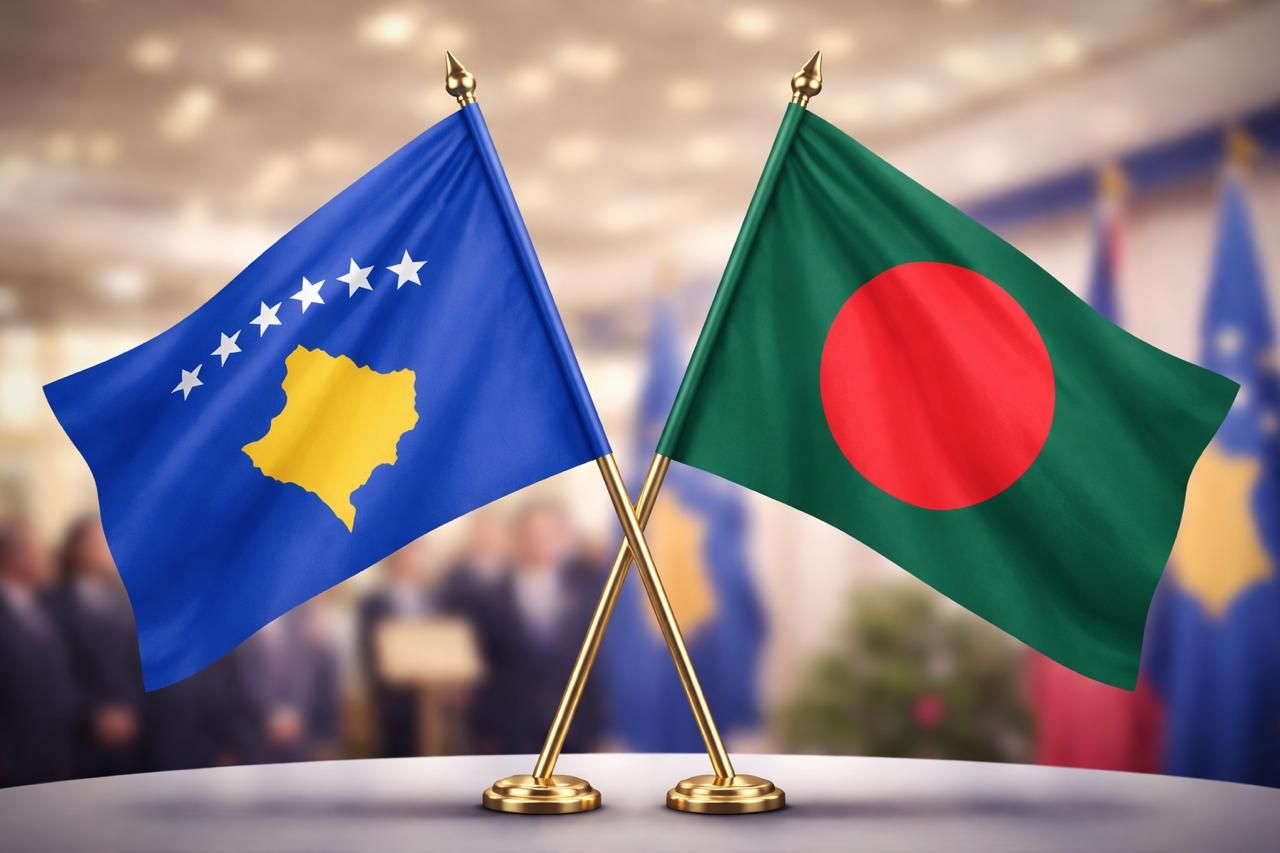
Kosovo declared independence from Serbia on 17 February 2008, but Bangladesh — pulled between U.S. encouragement and Russian pressure — delayed formal recognition for nearly a decade. As early as June 2008, Bangladeshi Chief Adviser Fakhruddin Ahmed signalled to the U.S. Embassy in Dhaka that Bangladesh would recognise Kosovo and would lobby Asian Muslim nations to do the same. However, Russia formally requested Dhaka to withhold recognition, and Bangladesh's desire to maintain ties with Moscow complicated the decision. By 2012, the then Prime Minister was hinting at 'good news soon,' and in December 2013 the Special Representative to the OIC said recognition would be seriously considered.
On 27 February 2017, Bangladesh formally recognised the Republic of Kosovo as an independent and sovereign state, with the then Prime Minister transmitting a verbal note to Kosovo PM Isa Mustafa. Exactly one year later — 27 February 2018 — Kosovo's Consul in New York, Teuta Sahatqija, and Bangladesh's Permanent Representative to the UN, Masud Bin Momen, signed a treaty officially establishing diplomatic relations. In 2019, Kosovo opened a resident embassy in Dhaka — one of its rare South Asian diplomatic presences — located at Floor-A6, House CEN(D)3, Road 95, Dhaka 1212. Bangladesh does not yet maintain a resident mission in Pristina.
Foundations: Shared History, Peacekeeping & Grameen Kosovo
A defining thread of the bilateral relationship is historical resonance. Kosovo's liberation from Serbian forces in 1999 — enabled by NATO intervention — and Bangladesh's independence in 1971 are both narratives of armed struggle, mass suffering, and sovereign triumph. Leaders on both sides consistently invoke this parallel as the moral bedrock of their partnership.
Bangladeshi UN peacekeepers served in the United Nations Interim Administration Mission in Kosovo (UNMIK) following the 1999 war, contributing to stabilisation and reconstruction. This service is held in high regard in Pristina and regularly acknowledged by Kosovar officials. Perhaps even more emblematic is Grameen Kosovo, established in 1999 as an extension of Nobel Laureate Professor Muhammad Yunus's microcredit model. It grew to become Kosovo's leading microcredit organisation, covering 219 villages and 20 municipalities — with 97 percent of its borrowers being women. This connection carries special symbolic weight today: Professor Yunus now serves as Bangladesh's Chief Adviser, making the Grameen Kosovo legacy a living bridge between the two nations' current leaderships.
On the legal-diplomatic front, the two countries have signed a Memorandum of Understanding on Bilateral Consultations, a General MoU on Cooperation, and an Agreement on visa-free travel for diplomatic and official passport holders. In 2022, Kosovo launched full visa and consular services at its Dhaka embassy. Negotiations are ongoing on agreements covering cultural and educational cooperation, economic collaboration, and avoidance of double taxation.
Ambassador H.E. Lulzim Pllana: Profile & Key Activities (2025–2026)
H.E. Lulzim Pllana presented his credentials to President Mohammed Shahabuddin at Bangabhaban on 14 January 2025, marking the beginning of an exceptionally active diplomatic tenure. Ambassador Pllana has pursued a wide-ranging agenda spanning high-level government engagement, academic diplomacy, cultural outreach, humanitarian action, and trade facilitation.
Government & High-Level Engagements
On 22 January 2025, Ambassador Pllana called on Foreign Secretary Md. Jashim Uddin, where Bangladesh urged Kosovo to recruit more Bangladeshi workers and streamline student visa processing. On 24 June 2025 — in a symbolically charged meeting — he paid his first call on Chief Adviser Professor Muhammad Yunus at the State Guest House Jamuna. The Chief Adviser highlighted sectors for Kosovo's investment in Bangladesh's Economic Zones: ready-made garments, pharmaceuticals, leather goods, jute products, processed food, and light engineering. The Ambassador recalled Grameen Kosovo's role in rebuilding Kosovar lives, stating: 'Bangladesh is a valuable partner for our freedom and development.'
Academic & Educational Diplomacy
On 27 April 2025, Ambassador Pllana visited Dhaka University, calling on Vice-Chancellor Prof. Niaz Ahmed Khan and delivering a lecture — 'The Republic of Kosovo Towards Euro-Atlantic Integration: Relations with Bangladesh' — at the Muzaffar Ahmed Chowdhury Auditorium. He outlined the existing bilateral agreements, detailed Kosovo's Diplomatic Academy training programmes for Bangladeshi junior diplomats, and announced Kosovo's Scholarship Program for Bangladeshi students. Both institutions agreed to sign an academic MoU soon.
On 9 October 2025, the Ambassador delivered the keynote at ULAB's Global Talks lecture series on 'Education and Trade as Bridges between Kosovo and Bangladesh,' describing the relationship as 'a partnership built on friendship, mutual respect, and shared aspiration — a bridge uniting South Asia and the Balkans.' He hosted Kosovo Film Day 2025 at North South University, drawing 250+ guests per session, while NSU formalised plans for academic partnerships with Kosovo's University for Business and Technology (UBT) and AAB College.
Cultural Diplomacy
In March 2026, the Kosovo Embassy collaborated with Alliance Française de Dhaka to screen the documentary Destination Francophonie: Kosovo — Welcome to the Heart of the Balkans, during the Francophonie Festival. Ambassador Pllana drew a meaningful parallel between Kosovo's French cultural engagement and Bangladesh's own Language Movement heritage, framing shared linguistic identity as a foundation for deeper cultural ties.
Humanitarian Cooperation: Rohingya Education
On 29 October 2025, Ambassador Pllana signed a Memorandum of Cooperation with the Association for Socio-Economic Advancement of Bangladesh (ASEAB), in the presence of the MoFA's Director General for the Myanmar Wing. Kosovo contributed €5,000 to supply school benches, bags, and water pots to Rohingya community learning centres in Cox's Bazar. The Ambassador stated: 'Education is not only a fundamental right but also a bridge to hope and resilience for children whose lives have been uprooted by conflict.'
Trade & Standards Engagement
On 6 October 2025, Ambassador Pllana led a delegation to the Bangladesh Standards and Testing Institution (BSTI), meeting Director General SM Ferdous Alam. Discussions covered mutual recognition of quality certificates, harmonisation of product standards, and pathways to expanding bilateral trade — laying technical groundwork for future export relationships.
Kosovo's Euro-Atlantic Integration: Implications for Bangladesh
Kosovo submitted its EU membership application in 2022 and continues advancing toward NATO membership, now recognised by over 120 states. In August 2025, the World Bank and IMF removed Kosovo from their list of fragile and conflict-affected countries — a milestone reflecting institutional confidence in its stability. Kosovo's GDP grew 4.4 percent in 2024 and is forecast at 3.8–4.0 percent through 2026, driven by private consumption and exports. As a full member of the Central European Free Trade Agreement (CEFTA), Kosovo trades tariff-free with six Western Balkan economies.
For Bangladesh, Kosovo's deepening Euro-Atlantic integration is strategically significant. A Kosovo embedded in EU regulatory frameworks could serve as a gateway for Bangladeshi exporters and investors to access European and Balkan markets with preferential conditions. Bangladesh's impending LDC graduation in 2026 — which will reduce duty-free market access in traditional export destinations — makes this alternative route commercially important. Kosovo's removal of customs duties on U.S. goods (August 2025) also signals a generally open trade orientation that Bangladesh should seek to leverage through early bilateral agreements.
Challenges
Despite genuine goodwill and diplomatic momentum, structural challenges remain. Geographic distance and the absence of direct air links between Dhaka and Pristina add cost and friction to business travel, student exchange, and people-to-people contact. Bilateral trade remains modest in absolute terms, with limited market awareness on both sides. The visa regime — requiring Bangladeshi citizens to obtain paper visas for Kosovo — also inhibits spontaneous exchange.
Kosovo's partial international recognition complicates matters in multilateral forums: major non-recognising states including Russia, China, and India are all important partners for Bangladesh, requiring Dhaka to navigate carefully. Bangladesh does not yet maintain a resident embassy in Kosovo, which limits its ability to service its citizens, facilitate business, or project influence in Pristina directly.
Future Prospects
The bilateral relationship is on a clear upward trajectory. The most promising near-term opportunity is the proposed textile sector bilateral agreement, advocated by Kosovo's President at UNGA in September 2025. Bangladesh's world-class garment manufacturing and Kosovo's import needs make this a natural fit — and if concluded, it could serve as a template for similar instruments in pharmaceuticals, leather, and processed food. Labour mobility represents another high-impact frontier: a formal agreement facilitating Bangladeshi workers' deployment to Kosovo, with clear rights and remittance channels, would benefit both economies.
In education, the formalisation of MoUs between Dhaka University and the University of Prishtina — and between NSU and Kosovo's UBT and AAB College — will create institutional pipelines for sustained academic exchange. Kosovo's Scholarship Program should be expanded, and joint research initiatives in areas of shared concern (climate adaptation, post-conflict governance, microfinance) could deepen expert networks. In multilateral forums, Bangladesh should continue supporting Kosovo's membership bids in Interpol, UNESCO, and other bodies, deepening its status as Kosovo's most important South Asian partner.
Looking further ahead, there is unexplored potential in digital economy cooperation: Kosovo's young, tech-savvy population and emerging startup scene complement Bangladesh's growing ICT sector. A formal digital cooperation framework — covering fintech, e-commerce, and technology transfer — could position both countries advantageously as they navigate post-LDC and post-conflict development transitions respectively.
Conclusion
Kosovo and Bangladesh are improbable partners by geographic accident but natural ones by historical kinship. Two nations that earned their sovereignty through sacrifice, shaped their identities through resistance, and built their futures through resilience find in each other a mirror and an ally. The formal relationship, less than a decade old in its recognised form, has already produced a resident embassy, multiple bilateral agreements, peacekeeping and humanitarian cooperation, academic partnerships, cultural exchanges, and growing trade aspirations.
Ambassador H.E. Lulzim Pllana has proven a transformative figure in accelerating this relationship — engaging Bangladesh's government, universities, civil society, and business community with remarkable energy and breadth. His tenure has taken the relationship from formal cordiality to genuine partnership. With strong political will on both sides, a growing legal framework, and concrete sectoral opportunities in trade, labour, and education, Kosovo–Bangladesh relations are well positioned to enter a new phase of substantive and lasting depth.
AKM Sayedad Hossain, Editor, Diplomatic and Foreign Affairs CNI News.
West-Middle East conflict, time for Bangladesh to tap the...
1
Misbah Chowdhury: World politics is changing rapidly. The Mi...
Algerian Independence Day: A Legacy of Freedom, Courage, ...
2
Decolonisation is the most radical change within the system of the twentieth century, the arch...
IBCCI promoting regional trade network within SAARC
3
President of the India-Bangladesh Chamber of Commerce and Industry (IBCCI) Md. Moshiur Rahman ...
Prime Minister Tarique Rahman’s “Bangladesh First” Doctri...
4
Dr Mohammad Tarikul Islam (MTI) is a Professor of Government and Politics at Jahangirnagar Uni...
Rohingya Repatriation May Take Years: Why Bangladesh Need...
5
Misbah Chowdhury: Bangladesh’s response to the Ro...



Comment (0)