





- Lead News
- National
Bangladesh is committed to building a trillion-dollar, climate-resilient economy
- লিড নিউজ
- National
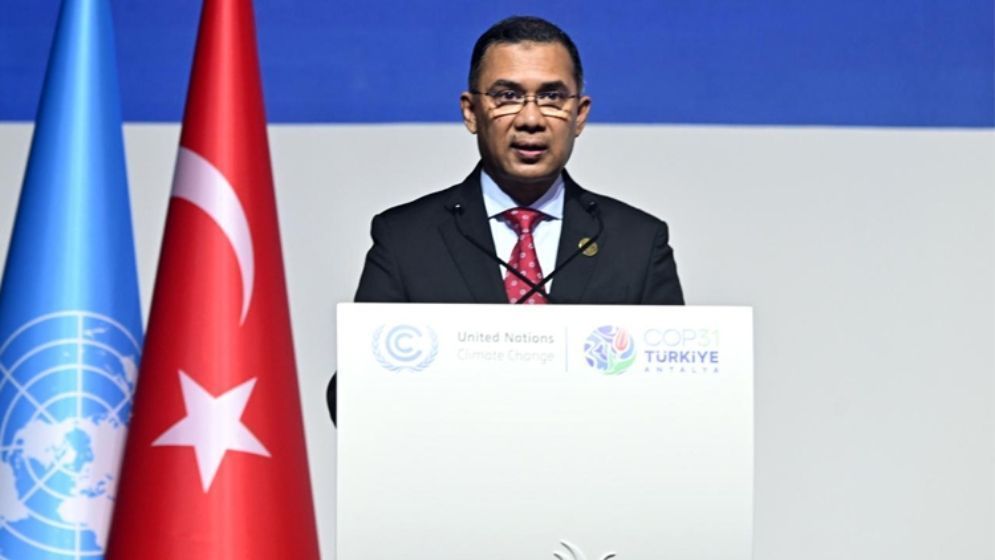
Photo: Collected
News Desk: Prime Minister Tarique Rahman has stated that the Bangladesh government is committed to building a one-trillion-dollar climate-resilient and sustainable economy.
He said, "Inspired by the 'Bangladesh First' philosophy, the government views economic growth and environmental protection as complementary to one another. Alongside industrialization and development activities, nature conservation and environmental balance must be maintained."
The Prime Minister made these remarks while addressing a high-level session of the United Nations Climate Change Conference (COP-31) in Antalya, Turkey, on Thursday.
The Prime Minister said, "Bangladesh is among the countries on the frontlines of climate change. Yet, Bangladesh's contribution to global greenhouse gas emissions is less than 0.5 percent. Despite this challenge, the government is working to build a climate-resilient and sustainable economy."
He added, "The government elected by the people's vote has set a target to meet 20 percent of the country's electricity demand from renewable energy by 2030. In line with the Paris Agreement, initiatives have been taken to generate 4,000 megawatts of solar power through special tax incentives to achieve net-zero emissions. Alongside this, waste-to-energy production is also being encouraged."
Mentioning that the government is encouraging green industrialization, Prime Minister Tarique Rahman said, "Currently, there are about 300 LEED-certified readymade garment factories in the country. Additionally, work is underway to expand eco-friendly transport systems including electric vehicles, promote environmentally friendly products like jute bags, and develop a national framework for carbon trading."
He said, "The government has taken a plan to plant 250 million (25 crore) trees over the next five years. Alongside the Padma Barrage and Teesta Barrage master plans, 20,000 kilometers of rivers and canals are being excavated to protect the environment and increase climate resilience. Through this, initiatives have been taken to conserve water, reduce flood risks, revitalize wetlands, and raise groundwater levels."
Highlighting initiatives to restore mangrove forests on reclaimed coastal land, the Prime Minister said, "This will strengthen the protection and climate resilience of coastal communities."
Referring to the limitations of the global climate finance system, the Prime Minister said, "The existing financing mechanism is still inadequate and does not properly consider the needs and priorities of developing countries. Climate change-induced loss and damage is creating a massive burden on the economy. Coupled with this, growing debt repayments and limited financial resources are making the situation even more difficult."
He said, "Climate-vulnerable countries need grants, not more loans. Reliable financial assistance, access to modern technology, and strong cooperation in climate adaptation activities must be ensured for them."
Noting that Bangladesh calls for five urgent actions to combat climate change based on the principle of 'Common but Differentiated Responsibilities and Respective Capabilities,' the Prime Minister said, "At least 50 percent of international climate finance must be allocated to adaptation activities. At the same time, emission reduction efforts must also be supported."
He called for introducing emergency debt and relief facilities for climate-vulnerable countries, ensuring fair access to eco-friendly technologies and technology transfer, and accelerating the transition to renewable energy through affordable financing and skill development.
Furthermore, he proposed adopting the 'Belém-Antalya Action Mechanism' at the COP-31 conference for a just energy transition based on fair financing and trade.
Emphasizing the importance of ensuring the participation of women and youth in climate action, the Prime Minister said, "We must work toward achieving the goal of limiting global temperature rise to 1.5 degrees Celsius by creating decent green jobs and reducing global greenhouse gas emissions."
Expressing hope for a successful COP-31 conference, the Prime Minister said, "Bangladesh hopes that meaningful, balanced, and ambitious outcomes will emerge from this conference, especially for the countries most vulnerable to climate change."
Calling upon other heads of state around the world, he concluded, "Let us turn our commitments into reality, strengthen global solidarity, and build a sustainable future together."
Law Minister: Sheikh Hasina Will Return to Bangladesh Thr...
1
News Desk: Law Minister Asaduzzaman has said that Sheikh Hasina will return t...
Food Minister: Tk 30 per Kg Rice Sales Programmed for Gar...
2
News Desk: Food Minister Afrozha Khanam Rita has said that the programme to s...

Local Government Left Out of Urban Planning
3
News Desk: Experts have expressed concern that local government institutions ...

Echoes of Freedom, Bonds of Friendship: A Musical Celebra...
4
Staff Correspondent: The Russian House in Dhaka, in cooperat...
Dhaka Forum Holds Strategic Meeting with the Prime Minis...
5
News Desk: Antalya, November 13, 2026 – On the sideli...



মন্তব্য (0)