- Diplomatic News
65th Anniversary of the October 17, 1961 Paris Massacre
- Diplomatic News
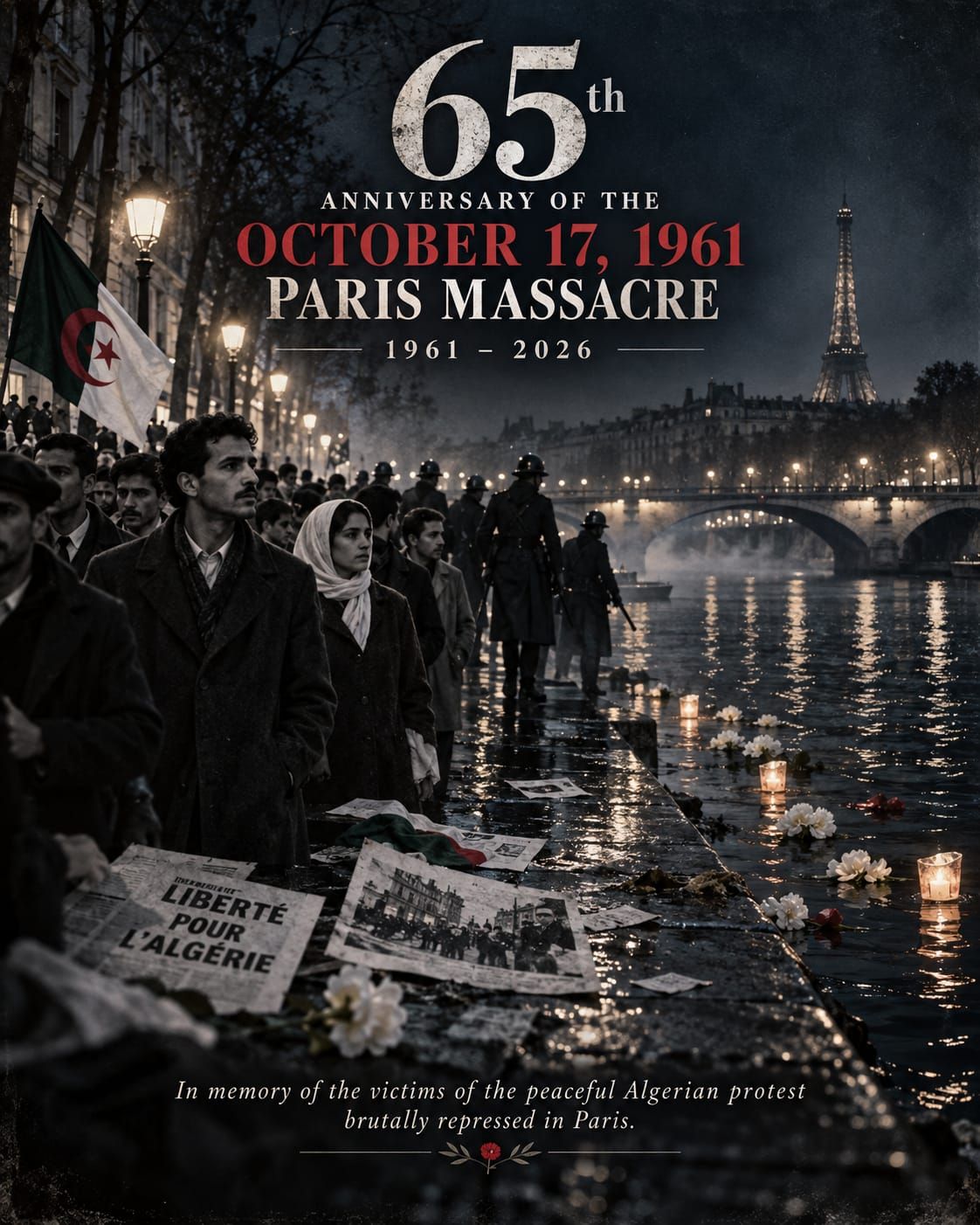
Photo: CNI
Diplomatic Correspondent: October 17, 2026, marks the 65th anniversary of the 1961 Paris massacre, one of the darkest episodes of France’s colonial history. On that night in Paris, French police violently repressed a peaceful demonstration attended by tens of thousands of Algerians. The protest was organized by the French Federation of the Algerian National Liberation Front (FLN) in opposition to a discriminatory nighttime curfew imposed specifically on Algerians during the height of the Algerian War of Independence.
The curfew had been introduced on October 5, 1961, by Paris police chief Maurice Papon. It specifically targeted people described by the authorities as “Algerian Muslims,” “French Muslims,” and “French Muslims of Algeria.” The measure was largely intended to disrupt the FLN’s urban networks. By restricting the movement of Algerian workers after 8:30 p.m., French authorities sought to weaken the FLN’s financial and logistical operations, including the collection of revolutionary taxes from Algerian migrant workers.
In response, on October 17, 1961, an estimated 30,000 to 40,000 Algerians marched through central Paris to protest the discriminatory curfew.
The police responded with extreme and systematic violence. Historians estimate that between 100 and 300 Algerians were killed, while approximately 12,000 to 14,000 protesters were arrested. Many demonstrators were beaten, shot, or otherwise subjected to severe physical abuse. Some victims were thrown into the River Seine, and bodies were subsequently recovered from the river.
Although the immediate context was the Algerian War of Independence (1954–1962), the massacre carried significance far beyond North Africa. It became an important symbol for anti-colonial movements across the Global South. In Africa, it resonated with liberation movements in the remaining French colonies and Portuguese territories, including Angola and Mozambique. It reinforced the belief that negotiations with colonial powers had to be accompanied by sustained resistance and international pressure.
In Latin America, revolutionary movements and left-wing intellectuals regarded the massacre as further evidence of the unwillingness of Western imperial powers to voluntarily surrender colonial control and recognize the right of peoples to self-determination. The brutality of the repression also strengthened the broader Pan-African and anti-colonial movements that had been shaped by the spirit of the 1955 Bandung Conference.
Whether a people was struggling against British, French, Portuguese, or other colonial rule, the Paris massacre became a powerful symbol of the lengths to which colonial authorities could go to preserve political control. The violence in the heart of the French capital demonstrated that colonial repression was not confined to distant territories; it could also be exercised against colonized populations living within the metropolitan center itself.
The French government initially attempted to suppress information about the massacre. Official accounts drastically understated the death toll, reporting only a small number of deaths. Mainstream French media largely reflected official police statements, while wartime censorship, political pressure, and self-censorship limited independent reporting. Foreign media also provided only sporadic coverage, as the Algerian conflict was frequently presented as an internal French security matter.
Alternative and left-wing publications, including L’Humanité and Les Temps modernes, attempted to document disappearances and gather testimony from survivors. However, journalists and publications faced censorship, confiscation, legal proceedings, and other forms of state pressure.
For decades, the massacre remained largely absent from France’s official historical narrative. Its memory was gradually recovered through the work of independent historians, researchers, journalists, survivors, and activists. Historian Jean-Luc Einaudi played a particularly important role in documenting the events and challenging the official version of the massacre. The gradual opening of government archives and renewed historical investigation further exposed the scale of the repression.
The legacy of Maurice Papon also became central to the historical reckoning. His later trial in 1997–1998, although focused primarily on his role in the deportation of Jews during the Second World War, brought renewed public attention to his position as Paris police chief during the Algerian War.
French authorities have gradually moved toward official recognition of the massacre. In 2012, President François Hollande acknowledged the “bloody repression” of the October 17 demonstration. On the 60th anniversary in 2021, President Emmanuel Macron commemorated the victims and described the police repression as an “inexcusable” and “unforgivable” crime. In March 2024, the French National Assembly adopted a resolution condemning the massacre. Nevertheless, historians and human-rights organizations continue to call for a comprehensive state apology, greater access to remaining archives, and stronger integration of the event into France’s national historical memory.
Sixty-five years later, the struggle over memory continues. Human-rights advocates, historians, descendants of victims, and civil-society organizations continue to demand that the massacre receive greater recognition in French education and public life. They also call for unrestricted access to remaining colonial-era records and for the event to be formally recognized as a state crime.
The October 17, 1961 massacre remains a profound historical reference point for discussions of human rights, racism, colonialism, police accountability, and state violence. Its suppressed memory has inspired generations of artists, writers, filmmakers, and intellectuals. Jacques Panijel’s documentary Octobre à Paris, despite early censorship, helped preserve testimony about the events, while Didier Daeninckx’s acclaimed novel Meurtres pour mémoire revisited the massacre through literature. The tragedy continues to appear in films, books, music, and historical scholarship that challenge official narratives of France’s colonial past.
The massacre also remains relevant to contemporary debates surrounding racial profiling, discrimination, police accountability, and the treatment of marginalized communities in France and Europe. For many scholars and activists, October 17 represents a historical link between colonial structures and forms of inequality that continue to shape modern society.
For generations, European colonial powers—including France—justified imperial expansion through the idea of a “civilizing mission,” presenting colonialism as a means of bringing law, democracy, and human rights to supposedly less-developed societies. Yet the violence inflicted upon Algerians in Paris exposed a profound contradiction: colonial repression was not merely an aberration occurring in distant territories. It was embedded in the structures through which colonial power was maintained.
Before 1961, many Western audiences perceived anti-colonial struggles primarily as distant conflicts taking place overseas. The events of October 17 brought the violence of the colonial struggle directly into the French metropolitan capital. For liberation movements across Africa, Asia, and Latin America, this carried enormous symbolic significance. It demonstrated that colonial power could be challenged not only on distant battlefields but also within the political and cultural centers of imperial powers.
The violence of the Algerian struggle also contributed to the intellectual development of anti-colonial thought. Frantz Fanon, whose seminal work The Wretched of the Earth was published in late 1961, analyzed the relationship between colonial domination, structural violence, and decolonization. His writings became enormously influential among liberation movements throughout the Global South.
The October 17 massacre must therefore be understood not merely as a tragic episode in the history of the Algerian War, but as part of the wider history of decolonization, human rights, and the struggle against racial and political oppression.
The October 17, 1961 Paris massacre remains a painful reminder of the human cost of colonialism and the importance of historical truth. Sixty-five years later, its memory continues to illuminate the Algerian struggle for dignity, justice, and independence—and to challenge societies to confront the violence hidden within their own histories.
“Russia–Bangladesh: Two Nations, One Screen” Celebrates ...
1
Diplomatic Correspondent: The Dhaka International Mobile Fil...
Bangladeshi Cultural Troupe Arrives in Islamabad to Stren...
2
Diplomatic Correspondent: A 15-member Bangladeshi cultural t...

Bangladesh Steps Up Efforts to Promote Sustainable Plast...
3
Staff Correspondent: The Department of Environment (DoE) and...
Chargé d’ Affaires Dr. Liu Yuyin Attends the BCCCI Celebr...
4
Diplomatic Correspondent: Chargé d’ Affaires Dr...
Pakistan High Commissioner Discusses Civil Service Capaci...
5
Diplomatic Correspondent: Pakistan High Commissioner to Bang...



মন্তব্য (0)