

- লিড নিউজ
- আন্তর্জাতিক
At the climate conference, Colombia’s President said that wars and fascism are increasing under the “self-destructive” model of capitalism
- Lead News
- আন্তর্জাতিক
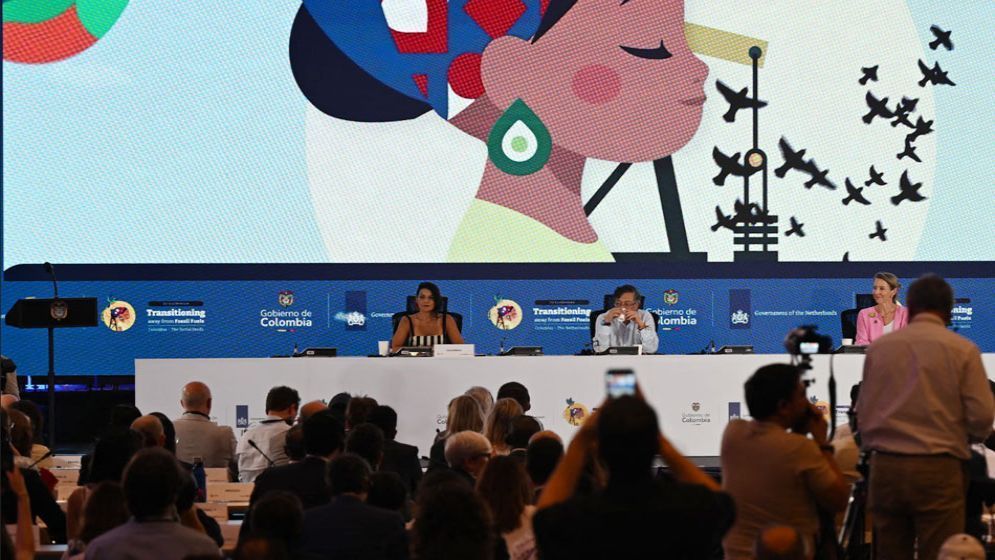
ছবিঃ সংগৃহীত
News Desk: At a conference involving representatives from 57 countries to address the climate crisis, Colombia’s President Gustavo Petro said the world is under threat due to a “self-destructive” model of capitalism. According to him, this model is pushing the world toward war, fascism, and even human extinction.
Petro accused fossil fuel–related groups of desperately trying to obstruct the transition to green energy. He stated, “This outdated form of energy—fossil fuels—which causes death, has a kind of inertia within power and the economy. Undoubtedly, this form of capitalism is not only self-destructive but could also destroy humanity and other living beings. The question now is whether capitalism can adapt to a model without fossil fuels.”
A former economist and guerrilla fighter, Petro was elected in 2022 as Colombia’s first leftist president. Under the country’s constitution, he cannot run for a consecutive second term, and citizens are set to vote for a new leader next month. Speaking on the current global situation, he warned, “We are heading toward barbarism, and that barbarism is a precursor to fascism.”
The world’s first conference focused on phasing out fossil fuels is being held in Colombia’s coastal city of Santa Marta. High-level government officials began a two-day discussion from Tuesday, following four days of workshops involving civil society members and academics.
Some countries have already started outlining plans to phase out fossil fuels. Colombia released its draft plan last week. Meanwhile, France—becoming the first developed country to do so—unveiled its national roadmap on Tuesday. The plan sets targets to eliminate coal by 2027, reduce dependence on oil by 2045, and completely phase out fossil gas by 2050.
France’s climate envoy Benoît Faraco said these targets are even more ambitious than those of the Paris Agreement. Although France has long relied on nuclear energy for much of its electricity, it now aims to expand renewable energy use. Faraco added that France aspires to become Europe’s “electric Saudi Arabia,” exporting green electricity to countries like the United Kingdom, Ireland, and Germany.
At the conference, developing countries and financial experts agreed that achieving climate goals is impossible without addressing the debt crisis. Tzeporah Berman, founder of the Fossil Fuel Treaty Initiative, noted that many Global South countries are forced to increase fossil fuel production just to repay debts. In Africa alone, debt has doubled over the past five years, surpassing $1 trillion.
Former Colombian Environment Minister Susana Muhamad said countries struggling with debt repayments find it nearly impossible to import essential goods like medicine or fertilizers without exporting fossil fuels. Civil society representatives at the conference also called for debt relief for less developed nations.
Although no major direct financial aid for developing countries is expected from this conference, it is paving the way for economic reforms—particularly how the $1.5 trillion in annual fossil fuel subsidies can be redirected toward environmentally friendly sectors.
পদত্যাগ না করার ঘোষণা পশ্চিমবঙ্গের মুখ্যমন্ত্রী মমতার
১
নিউজ ডেস্ক : পশ্চিমবঙ্গ বিধানসভা নির্বাচনে কারচুপির অভিযোগ এ...

আন্তর্জাতিক বাজারে বাড়লো তেলের দাম
২
নিউজ ডেস্কঃ হরমুজ প্রণালিতে যুক্তরাষ্ট্র ও ইরানের মধ্যে চলমা...

পশ্চিমবঙ্গে তৃণমূলের হেভিওয়েট প্রার্থীরা কে কার কাছে হার...
৩
আন্তর্জাতিক ডেস্ক: পশ্চিমবঙ্গের বিধানসভা নির্বাচনে বিদায়ী শা...

যে পাঁচ কারণে তৃণমূল কংগ্রেসের পরাজয়
৪
নিউজ ডেস্কঃ পশ্চিমবঙ্গের বর্তমান মুখ্যমন্ত্রী ও তৃণমূল কংগ্র...
বিধানসভা নির্বাচন: সংখ্যাগরিষ্ঠতা নিয়ে বিজয় নিশ্চিত করল ...
৫
নিউজ ডেস্কঃ পশ্চিমবঙ্গ বিধানসভা নির্বাচনে ২৯৩টি আসনের মধ্যে ...



মন্তব্য (০)