








- বিশেষ প্রতিবেদন
Even during the Eid season, there are no smiles on the faces of the weavers of Manikganj.
- বিশেষ প্রতিবেদন
ছবিঃ
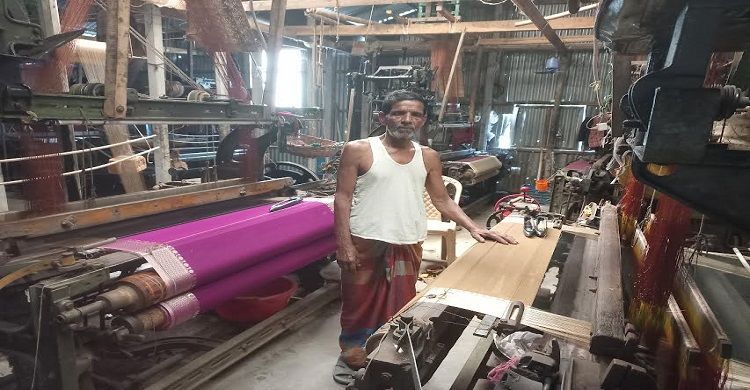
Manikganj Correspondent: Lavlu Mia (40), a weaver owner from Savar area of Saturia upazila of Manikganj, has 20 looms in his factory, but currently only 6 of them are producing saris and the remaining 14 looms have been closed due to lack of demand for cloth.
With Eid in front of them, the weaving village of Manikgandh usually comes back to life. But with Eid in front of them, there is no excitement this time, no noise of khat khat, jhum jhum day and night. While other times the weavers are busy during Eid, this time there is no smile on the faces of the weavers of Manikgandh during the Eid season.
The time before Eid-ul-Fitr is the happy season for weavers. But weavers wait for this season all year round. Because, during this time, both the price and demand of cloth increase. As a result, they are busy working day and night in the hope of additional income. The closed looms also become active during this season. Far from the closed looms being active during this desired season for weavers, weavers are struggling to keep the active looms active. Because although the prices of various materials used to make cloth including yarn and dyes have increased, the price of cloth has decreased. Due to which the owners have been forced to reduce the wages of the weavers. The owners are disappointed due to low sales and the weavers are disappointed due to the decrease in wages.
There are about 1500 weavers in the villages of Aga Savar, Savar, Jalshuka, Chachitara and Dighulia in Baraid Union of the district.
The handloom fabrics, three-pieces, and Punjabi fabrics produced in Saturia were once in demand in the showrooms of all the top famous bands in the country. The fabrics produced by the weavers of this area were also exported abroad. But now, due to the decreasing demand for handloom fabrics and the increasing prices of raw materials for handloom fabrics, including yarn and dyes, the marginal weavers of Saturia are not able to cover the production costs by making handloom fabrics.
Due to the Corona pandemic, the weavers of Saturia have not been able to do business for two years and the next few years. Although they have started their weaving factories with hope in view of the upcoming Eid, the weavers are not seeing any profit.
Md. Hanif (42), a loom worker from Savar village of the upazila, said that he has been weaving clothes for about 25 years. A few years ago, clothes were made by working day and night for a few months before Eid. If you make one piece of cloth, you could get a wage of 150 taka. Now, there is not much work ahead of Eid, there is no demand for cloth. Now, if you make one piece of cloth, you can get a wage of 80 taka. You can make 4 pieces of cloth in a day.
Weaver Habibur Rahman (65) said that he has been weaving for 40 years. There is no demand for woven cloth as before. Many of the cloths made by the moneylenders are being wasted as they cannot sell them. Currently, it is enough to say that there is no weaving work, because they cannot do other work, so they are forced to do this work even for low wages.
Md. Ratan, a weaver in Baraid, Upazila, said that the prices of the fabrics that were stored ahead of the Eid-ul-Fitr market are not increasing as the stored fabrics are now being released in the market. As a result, the fabrics that the weavers are currently weaving are not getting the expected prices in the market. There is currently no demand and no sales in the market for woven fabrics.
Loom owner Lavlu Mia said that the demand for woven cloth increases during various festivals. This time, the weavers, burdened with losses on their heads during Eid, have been busy making cloth, but they are disappointed because they are not able to sell their cloth in the market. Many have closed down their ancestral businesses due to fear of losses.
Local UP member Md. Dolowar Hossain said that 5 years ago there were about 2,000 looms in Savar area, but now there are 700. Weavers are quitting business day by day due to the Lokshan. Even 2 years ago, a loom cloth that could be sold for 1,000 taka is now being sold for 400 to 500 taka. The cost of making loom cloth has increased, but due to the decrease in selling price, loom owners are selling unprofitable looms. This time, weavers have not received any orders for Eid. Many looms are closed.
Comments (0)

জামালপুরে ঐতিহ্যবাহী ঘোড়া দৌড়, দর্শনার্থীদের উপচে পড়া ভিড়
১
জামালপুর প্রতিনিধি : জামালপুরের মেলান্দহে অনুষ্ঠিত হলো ঐতিহ্যবাহী ঘোড়া দৌড় প্...
রাণীনগরের অদম্য পাঁচ নারীর জীবন যুদ্ধের সফলতার গল্প
২
নওগাঁ প্রতিনিধি: সমাজের এমন কিছু নারী রয়েছেন যারা প্রতিনিয়তই...

৪ ডিসেম্বর: ইতিহাসের এই দিনে স্মরণীয় যত ঘটনা
৩
নিউজ ডেস্ক : বিশ্বব্যাপী প্রতিদিন ঘটছে নানা ঘটনা। সেসব ঘটনাই...
মাছ সংকটে পড়েছে চলনবিলের শুঁটকি চাতালগুলো: উৎপাদনে ধস
৪
পাবনা প্রতিনিধিঃ মাছের রাজ্য চলনবিলে এবার মাছের আকাল। পর্যাপ...
রাণীনগরের পাখি পল্লী পর্যটন এলাকায় নির্মাণ হচ্ছে দৃষ্টিনন...
৫
নওগাঁ প্রতিনিধি: নওগাঁর পর্যটন এলাকাগুলোর মধ্যে অন্যতম জেলার...



মন্তব্য (০)